
Allendale County Court Records After Arrest
After an Allendale County arrest, the first record is usually a jail booking. That booking may include the arresting agency's charge text, a warrant reference, bond notes, and release status. The filed court record is a different record set. It begins when the proper court receives a complaint, warrant, information, indictment, direct indictment, or other charging document. In South Carolina, Allendale County is part of Judicial Circuit 14, and trial-court case data is searched through the South Carolina Judicial Branch public index.
The distinction matters because jail charges can change. A deputy, municipal officer, or state trooper may book a person under one charge label, while the solicitor later reviews reports and decides what to prosecute. For custody and booking facts, use Allendale County jail inmate records. For booking photo questions, use the Allendale County jail mugshots page. For filed charges, case events, court dates, and dispositions after an arrest, the Public Index and the clerk's office are the main paths.
The South Carolina Judicial Branch courthouse listing for Allendale places the courthouse at 292 Barnwell Highway, Allendale, SC 29810, and identifies the county as Circuit 14. County elected-official records list Clerk of Court Elaine Sabb, esabb@allendalecounty.gov, 803-584-2737. Those court contacts answer case-file questions. They do not confirm whether a person is still inside the jail.
Search Allendale Court Records After Arrest
The best starting point for Allendale County court records after a jail arrest is the Allendale Public Index. The statewide South Carolina case records search also routes users to county public indexes. The Judicial Branch notes that cookies and JavaScript must be enabled. Some browsers also need a pop-up exception before case detail opens.
- Open the South Carolina Judicial Branch case records search or the direct Allendale Public Index link.
- Search by case number when it appears on bond papers, a warrant, a ticket, or a court notice.
- Search by party or defendant name if the case number is not known, then narrow by date or case type when fields are available.
- Open the case detail and read each charge, event, hearing date, disposition, and sentence field separately.
- Compare the filed case data with the jail booking record because the labels may not match.
The Public Index is a court case tool, not a live jail roster. It can show that a charge was filed, amended, dismissed, or set for a hearing. It does not prove that a person remains in custody at the Allendale County Detention Center, and it does not replace a call to the jail when the question is current custody or release.
The Judicial Branch Allendale courthouse page shows the local courthouse context and court links.
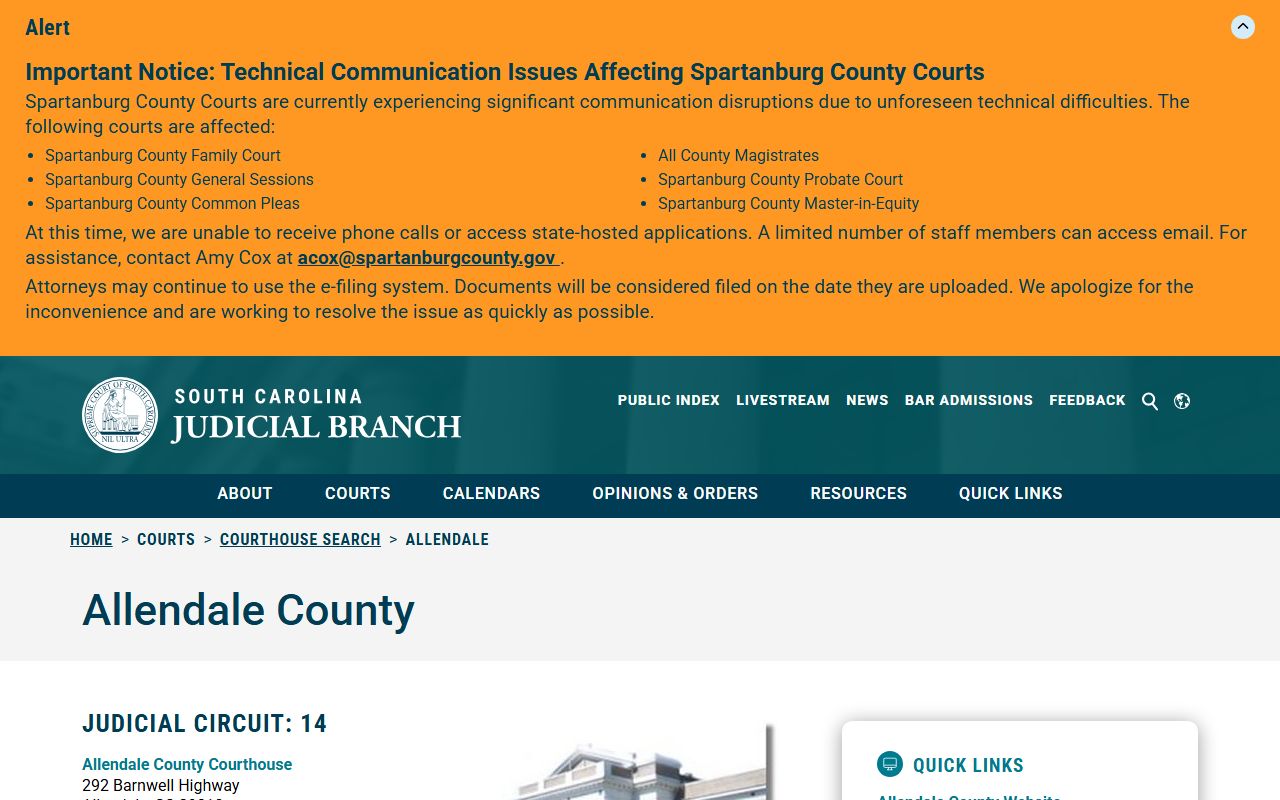
That courthouse source is useful for confirming that Allendale cases route through Circuit 14 and for separating courthouse business from jail custody questions.
| Field Label | Type | Required | Notes |
|---|---|---|---|
| County | Selected county link | Yes | Use Allendale from the Judicial Branch case records search or the direct Allendale Public Index. |
| Case Number | Text | No | Best when copied from a warrant, ticket, bond form, or court notice. |
| Party Name | Text | No | Search by defendant name and try alternate spellings when no result appears. |
| Date or Case Criteria | Filter | No | Available fields can vary, and browser settings may affect case detail windows. |
| Search or Submit | Button | Yes | Use after accepting the public-index terms and enabling required browser features. |
Allendale Arrest Charges in Court
The Fourteenth Circuit Solicitor's Office prosecutes criminal cases for Allendale, Beaufort, Colleton, Hampton, and Jasper counties. The official solicitor site is scsolicitor14.org, and the office's case tracking page points users back to public-index case status tools. County agency research lists Solicitor Isaac McDuffie Stone III, P.O. Box 1880, Bluffton, SC, solicitor@scsolicitor14.org.
The solicitor's review is one reason court records after an arrest may not mirror the jail booking. Law enforcement creates the arrest and booking record. The solicitor reviews reports and evidence and decides whether to proceed, amend, reduce, add, dismiss, or present charges to a grand jury. The public index then shows the filed case data when entered by the court.
The Fourteenth Circuit case status page links the prosecutor's case-tracking role to the South Carolina public index system.
The solicitor source helps explain why the court record should be checked after booking, especially when the jail charge is only the first version of the accusation.
Allendale Charging Documents After Arrest
Allendale County court records after arrest can begin through more than one charging route. A complaint or warrant may start a lower-court or initial criminal matter. An indictment reflects grand-jury action in qualifying cases. A direct indictment or information can also appear where allowed by South Carolina procedure. The key point is simple: the jail booking starts custody, while the charging document starts or shapes the court case.
| Document | What It Does | How It Affects Search |
|---|---|---|
| Complaint or warrant | States the alleged offense and supports arrest or initial court action. | May supply a case or warrant number before later solicitor action. |
| Information | Prosecutor-filed charge document where legally available. | Can differ from the booking charge listed by the jail. |
| Indictment or direct indictment | Formal felony charging path tied to General Sessions practice. | May create a new case event or charge label in the Public Index. |
| Other court order | Includes bench warrants, bond orders, commitments, or disposition orders. | Look under events, hearings, and disposition fields, not just the charge line. |
A filed charge does not equal guilt. It is the formal accusation that lets a criminal case proceed. The final disposition may be a plea, trial verdict, dismissal, nolle prosequi, amendment, diversion result, or expungement-eligible outcome.
Allendale Charge Status Records
Charge status is the part of the court record that often answers the real search question. A pending charge means the court case is still active. A dismissed charge ended without conviction. Nolle prosequi means the prosecutor declined to go forward on that charge. An amended or reduced charge means the filed accusation changed after review, plea negotiation, hearing, or court order.
| Status | Meaning | What to Check Next |
|---|---|---|
| Pending | The charge remains open and has not reached final disposition. | Check court dates, bond conditions, and solicitor events. |
| Amended or reduced | The charge text or severity changed after filing. | Compare old and new charge rows before treating either as final. |
| Dismissed | The charge ended without a conviction on that count. | Ask the clerk about certified disposition copies if proof is needed. |
| Nolle prosequi | The solicitor chose not to proceed on that charge. | Review whether other charges in the same case stayed active. |
| Disposed or sentenced | The case reached a plea, verdict, sentence, or other final court action. | Search SCDC if the sentence led to state prison custody. |
When a record is unclear, use the Clerk of Court for certified copies or older records not visible online. For statewide criminal-history products, South Carolina Law Enforcement Division handles criminal-history checks separately from the Judicial Branch Public Index.
Bond and Warrants After Arrest
Bond can appear early in the arrest-to-court path. South Carolina uses cash bond, surety bond, personal recognizance or non-surety release, property bond in some settings, and no-bond holds. Allendale-specific bond payment instructions were not located on an official jail page. Call the Allendale County Detention Center at 803-584-4616 before posting bond, and ask about all charges, all holds, the court that set bond, payment location, hours, and accepted payment type.
| Bond Type | How It Works | Allendale Research Note |
|---|---|---|
| Cash bond | Money is paid to secure court appearance. | Payment place and method were not posted locally. |
| Surety bond | A commercial bondsman or surety posts bond. | Verify the accepted process before travel. |
| Personal recognizance | Release is based on a promise and court conditions. | Only the court can set this release type. |
| Property bond | Property may be pledged where allowed. | Confirm with the court or clerk before relying on it. |
| No-bond hold | Release is blocked until further court action. | May involve serious charges, warrants, detainers, or judicial order. |
No official Allendale active warrant list or sheriff warrant search was located. Use the sheriff or detention phone, the Allendale Public Index for bench-warrant or failure-to-appear events, and the court that may have issued the warrant. Private warrant sites should not be treated as official Allendale County records.
Charges Convictions Sealed Expunged
Allendale County court records after a jail arrest can show accusations long before a final outcome. Treat charges, convictions, sealed records, and expunged records as separate legal states. South Carolina FOIA, Title 30 Chapter 4, supports access to many public records, but Section 30-4-40 includes exemptions that can affect law-enforcement, privacy, juvenile, investigation, and security-sensitive material. Expungement law appears in Title 17 Chapter 22, including Section 17-22-910.
| Question | Charge | Conviction |
|---|---|---|
| What it is | An accusation filed or carried in a case. | A guilty plea, verdict, or qualifying final judgment. |
| Proof level | Based on probable cause and filing standards. | Based on plea or proof beyond a reasonable doubt at trial. |
| Record meaning | Does not prove guilt. | Shows a final criminal outcome unless later changed by court order. |
| Question | Sealed | Expunged |
|---|---|---|
| Public access | Hidden or restricted from ordinary public view. | Removed or treated as not publicly available after a valid order. |
| Who may see it | Limited users may retain access under law or court order. | Access is more limited, but exact effects depend on the order and statute. |
| Allendale path | Ask the court or clerk about the order that restricts the file. | Use South Carolina expungement law and court records to verify eligibility and status. |
South Carolina FOIA and South Carolina expungement statutes control the public-record boundaries. Do not assume a dismissed charge has disappeared from every system until the court record and any expungement order are checked.
Allendale Court Rosters and Dates
Court rosters answer a narrower question than the Public Index. They help locate scheduled appearances, but they are not a warrant list and not a jail roster. The South Carolina court roster search includes county roster access, including Allendale, when rosters are posted through the Judicial Branch system.
Use a roster to confirm a hearing date, then return to the Public Index for filed charge details, case events, and disposition entries. If a case does not appear online, contact the Allendale County Clerk of Court for older, certified, or locally maintained records.
The Judicial Branch court roster source shows the statewide path for scheduled court events.
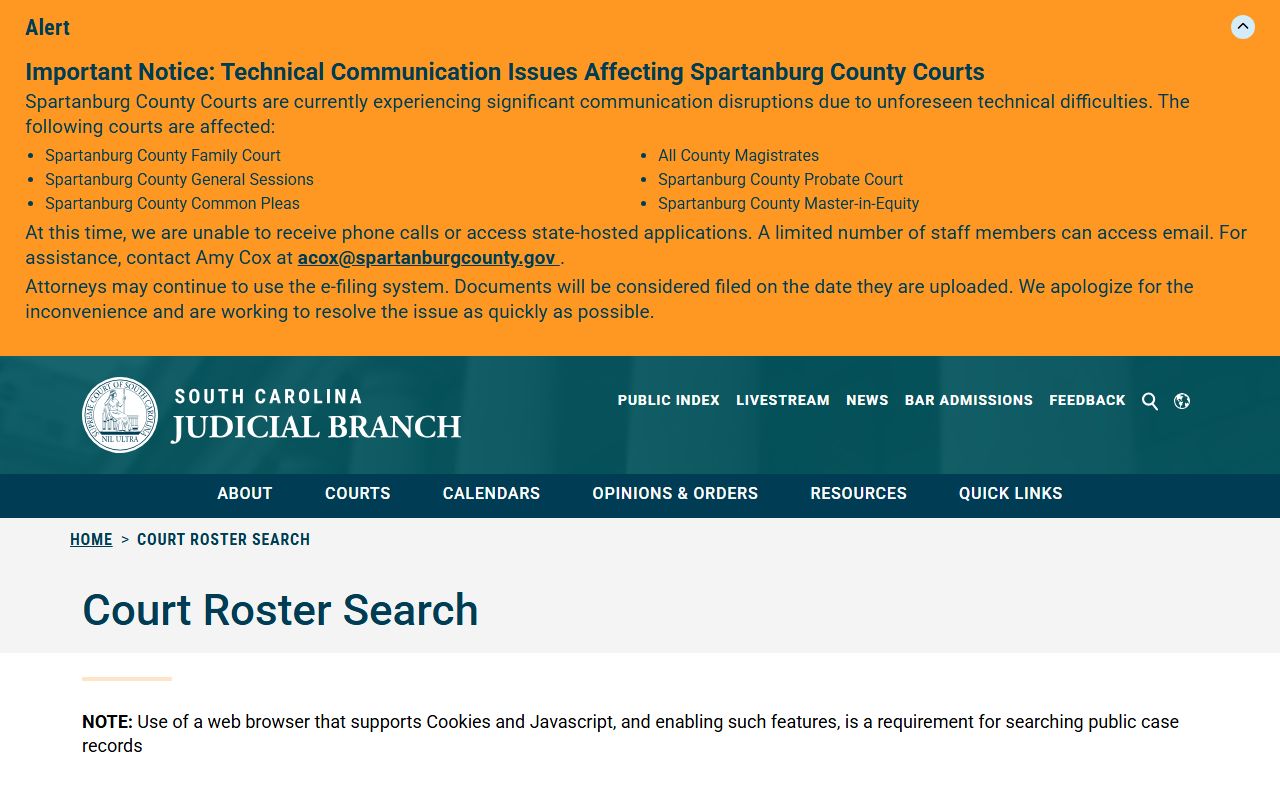
A roster entry should be read with the case file, especially when bond, warrants, or multiple charges are involved.
Restricted Allendale Arrest Court Records
Some court records after an arrest may be limited, redacted, sealed, or absent from public web results. Common reasons include juvenile status, expungement, sealed orders, active investigations, victim data, medical information, protected identifying information, and security-sensitive detention details. South Carolina FOIA does not force release of every record in every form.
For official proof, ask the Clerk of Court about certified copies or file access. For jail booking records, ask the sheriff or county custodian under FOIA. For current custody, call the detention center. Each office answers a different part of the same arrest-to-court path.
Important: A public case lookup is not a consumer report and must not be used for FCRA-covered screening decisions.